
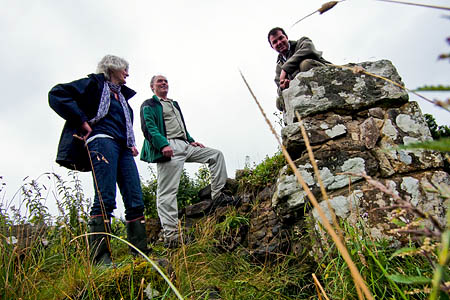
Jan Ashdown of TAG with Graham Gill of the Forestry Commission and MP Guy Opperman at the ruins of Shilla Hill Bastle. Photo: Mark Pinder
A series of new trails has been set up to lead walkers through the sites of bloody Borders raids that left residents in fear of their lives.
The Tarset Bastle Trail is the result of collaboration between the Forestry Commission and Tarset Action Group in the Kielder Water and Forest Park in Northumberland.
Bastles were fortified farmhouses built mainly in the late 16th century to protect families from raiders from both sides of the Border.
To make the families’ lives even more difficult a climatological shift to colder weather added to the woes of farmers trying to eke an existence from the land, while also warding off attackers.
A choice of waymarked routes up to 13km (8 miles) long is available for walkers wanting to learn more about the archaeology lurking amongst the trees.
New storyboard panels have also been erected and a new leaflet produced by TAG and funded by the Northumberland National Park Authority.

Black Middens bastle. Photo: Tim Bird
Neville Geddes of the Forestry Commission said: “Bastles stand as a testament to a violent past when life could be nasty, brutish and short.
“Kielder is a very surprising place and by getting off the well-worn path you can find remarkable relics such as these.
“TAG has done a brilliant job working with our rangers to design the route and produce fascinating interpretation boards to make sense of the haunting ruins.”
The trail passes four accessible sites: Boghead, Hill House, Black Middens and Shilla Hill and also takes in an Iron Age site at least 2,000 years old. Other off-limits bastles, on private land but still visible, are also marked.
Jan Ashdown, TAG coordinator, added: “It’s been a great partnership project and we were able on draw on the group’s bastle studies, which culminated in the 2009 Bastle Exhibition, to design and produce the panels and commission a beautiful hand-painted map.
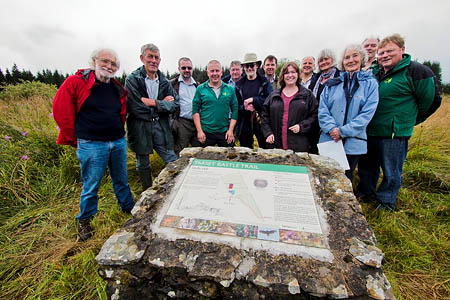
One of the interpretation boards on the trail. Photo: Mark Pinder
“The route makes it easy for people to explore this wonderful place. For us in Tarset bastles have a constant presence. You can find the remains of them in walls, and people’s gardens, and even incorporated into houses. They are a rich part of the unique cultural heritage of this stunning part of Northumberland.”
The trail, in the 62,000ha (155,000-acre) area, was opened by Hexham MP Guy Opperman.
During the reiving period Tarset was in the front line, just as it had been during the Border wars. Nearly all the bastles on the trail were repeatedly attacked.
On 30 August 1583, Kinmont Willie with some 300 other Armstrongs sacked eight farmsteads in Tarset, killing six people, taking 30 prisoners and driving away a large quantity of livestock. It was many years after the accession of James 1 in 1603 before peace finally returned to Tarset.


