
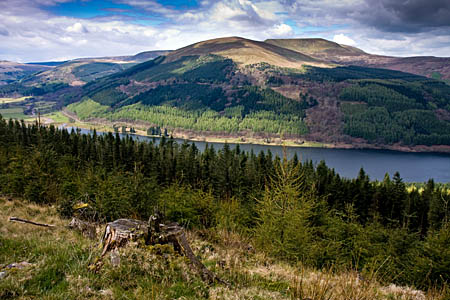
The outbreak has affected trees in the Talybont Valley
Outdoor enthusiasts are being urged to clean up their gear and clothes to help stop the spread of a tree disease in a national park.
The outbreak of phytophthora ramorum is threatening woodland in the Brecon Beacons, including a forest on one of the routes to the area’s highest mountain.
The Brecon Beacons National Park Authority said the highly infectious disease, which is harmless to humans and animals, has been discovered in 49ha (120 acres) of forest in the upper Taf Fechan and Talybont valleys.
The Taf Fechan Forest lies on one of the main southerly approaches to Pen y Fan, south Wales’s highest mountain.
Walkers and mountain bikers could be helping the disease spread, leading to the premature felling of a large number of larch trees in the area, managed by Forestry Commission Wales.
A spokesperson for the authority said: “Public access in the affected areas will continue as normal for the time being, however Brecon Beacons National Park Authority, together with its partners at Forestry Commission Wales, are asking walkers and cyclists to do everything they can to stop the disease spreading further.”
Signs have been put up in the area asking walkers to help stop the disease infesting other areas.
National park staff said visitors can help by ensuring they and their dogs keep to the paths; brush off any loose mud and dirt from their footwear, clothing and bicycles in the car park; and thoroughly clean their footwear and bikes at home before their next visit.
Paul Sinnadurai, conservation manager for Brecon Beacons National Park Authority, said: “Our wardens are working with Forestry Commission Wales to take all necessary precautions – cleaning clothes, boots and disinfecting too – when entering infected woodlands and we would urge visiting members of the public to follow Forestry Commission Wales’ advice to brush down, brush off and wash off when you get home too.
“This fungal disease is known to be present within a few forestry plantations in south Wales and is known to attack other common plants like rhododendron and viburnum.
“We hope that people will help our efforts to minimise the spread of the fungal spores because this species also has the potential to mutate and it is possible that it could infect other important plant species such as bilberry.”
The latest outbreaks are the largest yet identified on the Welsh Government woodland estate in the national park and the infected trees will shortly be felled as part of ongoing work to halt the spread of the disease.
Previous outbreaks of phytophthora ramorum, in the Glasfynydd and Penmoelallt forests, have been much smaller.
Last year, a large block of larch trees adjacent to National Trust Wales-owned land at Pont ar Daf car park, popular with walkers heading for Pen y Fan from the South-West, had to be prematurely felled after contracting the disease.
The most recently affected areas in Taf Fechan and Talybont include two Forestry Commission Wales car parks, at Owl’s Grove and Upper Blaen y Glyn. Both car parks will be closed during felling operations, which should be completed by 31 March next year.
Timber from the felled larch trees will be sold to sawmills licensed to handle infected material. Felled areas will be replanted in due course with tree species which are not susceptible to ramorum disease.


