
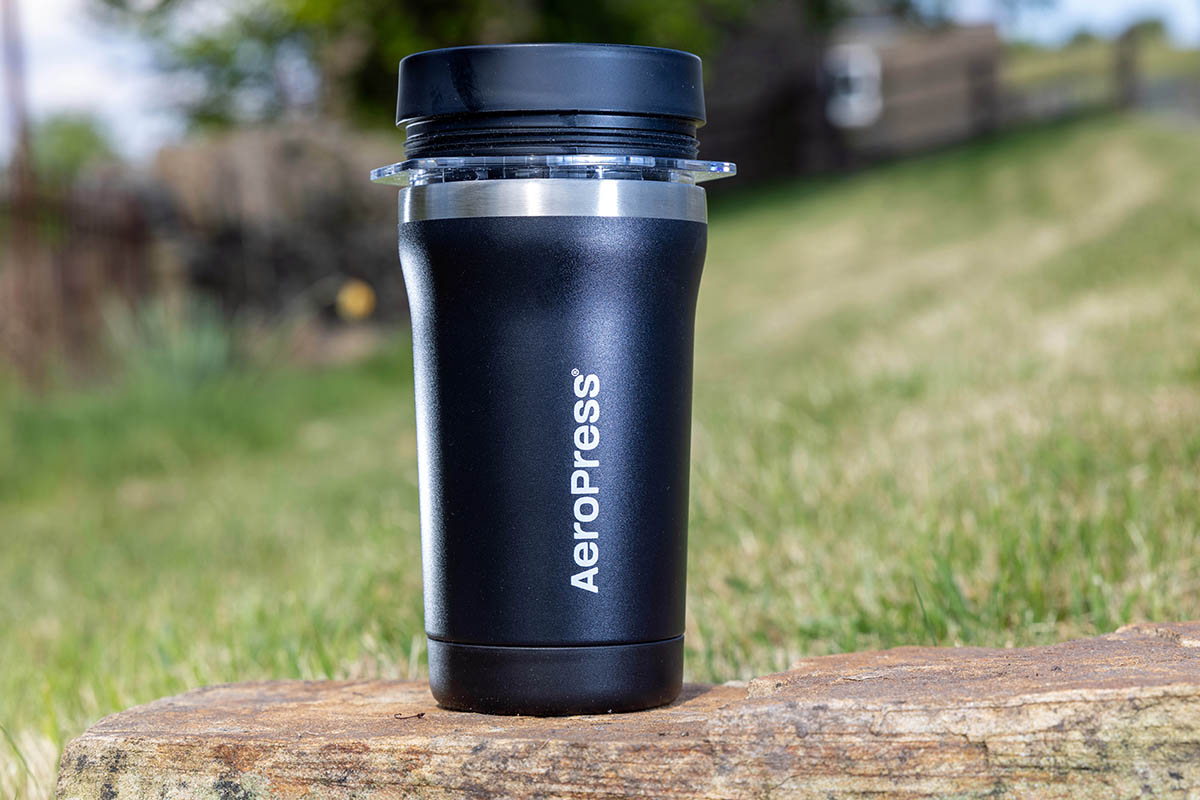
The AeroPress Go Plus. Photo: Bob Smith Photography
Price: £89.99
Weight: 564g
Country of manufacture: USA/China
I must admit I can be in a bit of a zombie state before I have my morning caffeine fix, and that applies even when I’m breathing in the fresh mountain air at camp.
One of my pet hates is that sachet of instant coffee you find even in some upmarket hotels. It’s tempting to take the easy route and snaffle a few of these on my trips to simplify matters when I crawl out of my sleeping bag, but nothing compares to a cup of proper coffee when in the great outdoors.
I’ve previously used the basic AeroPress coffee maker so was happy to put the Go Plus model to the test. I’ve used this latest coffee maker over the past three months, both at camp and when staying in hotels – so I can avoid those dreaded instant sachets.
The Go Plus is essentially the basic AeroPress with the addition of an insulated stainless steel mug and drinking lid.

The parts of the Go Plus. Photo: Bob Smith Photography
It all fits together fairly neatly for packing into your rucksack or duffel and is pretty easy to use.
At the core of the coffee maker is a cylindrical reservoir into which the ground coffee goes. But first you have to take off the plastic filter cap at its base. Into this you place one of the special circular AeroPress micro-filter papers that are stored in a screw-off section at the bottom of the mug. The Go Plus comes with a supply of 100 of these. Extra micro-filters can be bought for £8.99 for 350, at the time of writing.
Lock the base onto the main chamber and then spoon your ground coffee into the cylinder, with the supplied plastic scoop. While you’re doing this you can be heating your water on your stove (or use the hotel kettle!)
The chamber, with the coffee in it, then sits on top of the insulated tumbler. A hexagonal lip stops the cylinder falling into the mug. Pour in your hot water, ideally just off the boil, into the chamber. It has markings on the side – AeroPress recommends filling it up to the number four mark.
Take the fold-out plastic stirrer and give the coffee a good stir and then use the plastic plunger, which has a snug-fitting silicone element at the bottom, and press it a little way into the chamber. This stops the remaining brewing coffee filtering into the mug.

The plunger forces the coffee through the filter and into the mug. Photo: Bob Smith Photography
Leave the coffee to sit for a couple of minutes then push the plunger all the way to the bottom of the chamber, squeezing the coffee through the filter and into the mug.
You then have a piping cup of fresh coffee in an insulated tumbler which will help keep it hot and also means there’s no problem holding a too-hot container. The mug comes with a lid that sits snugly on top of it. A double rubber o-ring helps stop spills and you can use the sip hole with its sliding cover. It’s worth pointing out, however, that the lid isn’t leak-proof if inverted, so I can’t recommend using it as a flask when travelling with your drink.
After use, you just have the used filter paper and coffee puck (the used grounds) to dispose of. The coffee maker is easy to clean after that and the whole thing fits, mostly, neatly together for storing. The stirrer folds at the bottom and handle and, together with the scoop, fits inside the hollow plunger. If you then invert the mug, it goes over this assembly with the base of the chamber and plunger at the top. The least neat part of the coffee maker is the mug’s lid, which sits firmly but a little awkwardly-looking on top of everything.
I’d say the Aero-Press Go Plus is just a little heavy and bulky, at 18.5cm x 10cm for wild camping, but it’s ideal for base camping, campervanning and glamping. It’s also great for use in your hotel room and there are many aficionados of the AeroPress who use them at home.
The coffee it produced was very good – lacking in bitterness thanks to the micro-filter, yet with a good, full flavour. It’s a sort of semi-espresso process thanks to the pressure from the plunger, but don’t expect that espresso crema on top. It did have a very smooth and full taste and the method of making coffee with it is pretty simple.

The mug keeps your coffee hot. Photo: Bob Smith Photography
In terms of sustainability, the only waste produced is the small filter paper and the coffee grounds. If you’re using it at home, you might want to try using the grounds as garden fertiliser. All the parts of the Aero-Press are reusable and replacement parts are available on online. Though it does use stainless steel and Tritan plastic, the latter is BPA-free. Reusing drinking vessels is obviously more sustainable in the long run that single-use plastics. The components felt sturdy.
Other than the above observations, there is very little information on the company’s sustainability.
I’ve used the AeroPress Go Plus extensively over the past few months and it now has a permanent place in my kit.
Performance: 35/40
Ease of use: 25/30
Quality: 7/10
Value for money: 6/10
Sustainability: 7/10
Total score: 80/100
The AeroPress Go Plus was supplied to grough by TKC Sales.


